



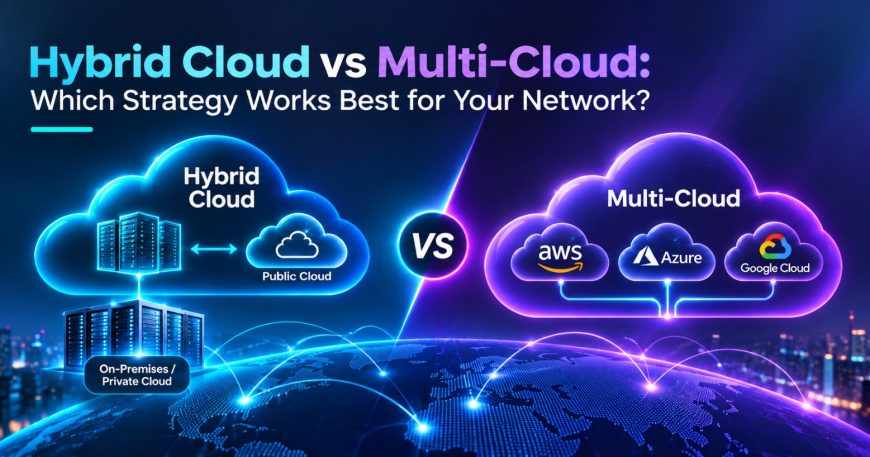
Hybrid Cloud vs Multi-Cloud: Which Strategy Works Best for Your Network?
Hybrid cloud and multi-cloud take very different approaches to networking. Compare the benefits, challenges and trade-offs to choose the right strategy for your organization.
As enterprises scale their digital infrastructure, one question keeps surfacing in IT and networking boardrooms: should we go hybrid cloud, multi-cloud, or both? While the terms are often used interchangeably, they represent fundamentally different architectural philosophies — especially from a networking standpoint. Choosing the right strategy affects everything from latency and bandwidth costs to security posture and disaster recovery.
Let’s break down both approaches, weigh their benefits and challenges, and look at how the right networking partner can make either strategy succeed.
What Is Hybrid Cloud?
Hybrid cloud combines on-premises infrastructure (or a private cloud) with one public cloud provider, connected through a dedicated, secure network link. Data and workloads move fluidly between the two environments based on performance, compliance, or cost needs.
Benefits
- Data control and complianceSensitive data stays on-prem or in a private cloud, satisfying regulatory requirements (HIPAA, GDPR, PCI-DSS) while less-sensitive workloads run in the public cloud.
- Cost optimizationPredictable workloads run on owned infrastructure; unpredictable, bursty demand scales into the public cloud (cloud bursting).
- Simplified networkingWith only two environments to connect, network architecture, routing policies, and security rules are easier to design and maintain than juggling multiple providers.
- Legacy system integrationOrganizations with heavy investments in legacy systems can modernize gradually instead of a risky full migration.
Challenges
- Network latency between environmentsPoorly designed connectivity (VPN vs. dedicated circuits like AWS Direct Connect or Azure ExpressRoute) can introduce lag for latency-sensitive applications.
- Consistent security policy enforcementMaintaining uniform firewall rules, identity management, and encryption across two very different environments is non-trivial.
- Bandwidth costsConstant data movement between on-prem and cloud can rack up egress charges if not architected carefully.
- Skill gapsTeams need expertise in both traditional networking and cloud-native networking (SD-WAN, virtual routers, cloud VPCs).
What Is Multi-Cloud?
Multi-cloud means using two or more public cloud providers (e.g., AWS, Azure, Google Cloud) — often without any private/on-prem component — to distribute workloads, avoid vendor lock-in, or leverage best-of-breed services from each provider.
Benefits
- Avoiding vendor lock-inNegotiating leverage and flexibility to choose the best service for each specific workload (e.g., Google Cloud for AI/ML, AWS for compute scale).
- Resilience and redundancyIf one provider has an outage, workloads can fail over to another, improving business continuity.
- Geographic and regulatory reachDifferent providers have different regional footprints, helping meet data residency laws across countries.
- Best-of-breed innovationTeams aren’t limited to one provider’s roadmap or pricing model.
Challenges
- Network complexity multipliesEach additional cloud provider means new VPCs, peering connections, routing tables, and security groups to manage — often with different terminology and tooling per vendor.
- Inter-cloud latency and data transfer costsMoving data between clouds (not just to/from on-prem) can be expensive and slow without optimized interconnects.
- Fragmented visibilityMonitoring performance, traffic flow, and security incidents across multiple cloud consoles is operationally heavy without a unified network management layer.
- Talent and tooling overheadTeams need multi-vendor certifications and often a mesh of third-party tools just to get a single-pane-of-glass view.
So, Which Strategy Wins?
There’s no universal answer — it depends on your organization’s priorities:
| Choose Hybrid Cloud if… | Choose Multi-Cloud if… |
|---|---|
| You have significant on-prem/legacy investment | You’re cloud-native or fully cloud-migrated |
| Compliance demands data stay on-prem | You want resilience against provider outages |
| You want simpler, more controllable networking | You need best-of-breed services across vendors |
| Cost predictability matters most | Avoiding lock-in is a strategic priority |
The hybrid multi-cloud model
Many enterprises, in fact, land on a hybrid multi-cloud model — combining private infrastructure with multiple public clouds — to get the best of both worlds. This is increasingly common but also the most network-intensive to get right.
The Networking Reality Nobody Talks About Enough
Regardless of which path you choose, the strategy lives or dies on the network layer. Poor interconnectivity design leads to:
How RaceAhead Can Help
This is exactly the gap RaceAhead is built to close. As a networking-first partner, RaceAhead helps organizations design, deploy, and manage the connective tissue between hybrid and multi-cloud environments:
Optimized interconnects
Architecting low-latency, high-bandwidth links (dedicated circuits, SD-WAN, or cloud exchange fabrics) between on-prem and cloud, or across multiple cloud providers.
Unified network visibility
A single-pane-of-glass view across all environments, so your team isn’t toggling between five different cloud consoles to troubleshoot an issue.
Consistent security posture
Standardizing firewall policies, identity, and encryption across every environment, reducing the risk of misconfigurations that lead to breaches.
Cost-aware traffic engineering
Smart routing that minimizes expensive data egress and inter-cloud transfer fees without sacrificing performance.
Expert-led migration and design
Hands-on architecture support so your team isn’t learning multi-vendor networking on the fly.
Whether you’re just starting your hybrid cloud journey or scaling into a complex multi-cloud footprint, RaceAhead ensures your network is an enabler of your cloud strategy — not the bottleneck holding it back.
Final Thoughts
Hybrid cloud and multi-cloud aren’t competing philosophies — they’re tools suited to different needs. The real differentiator isn’t which model you pick, but how well your network is architected to support it. Get the networking foundation right, and either strategy or a blend of both can deliver the agility, resilience, and cost efficiency your business needs to move forward with confidence.
Race Ahead IT Solutions
Insights on enterprise networking, hybrid cloud and multi-cloud strategy for technology leaders.